 1126
1126Sellers on Amazon have probably all experienced this: Prime Day or Black Friday is right around the corner, but your products just can't get into the FBA warehouse—either storage capacity is insufficient, or restocking is too slow. You watch the traffic come in while your inventory can't keep up. Only those who have experienced it know how that feels.
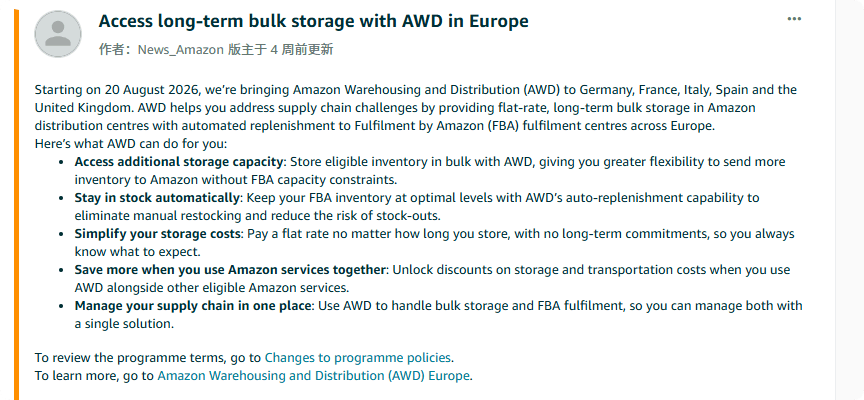
Amazon has clearly seen this pain point. On August 20, Amazon's Amazon Warehousing & Distribution (AWD) bulk warehousing service officially launched in Europe, covering five countries: Germany, France, Italy, Spain, and the UK. These five countries are not only Europe's largest e-commerce markets, but also the core regions of Amazon's business. This is also the first time AWD has expanded beyond the U.S. market since its launch there in 2022.
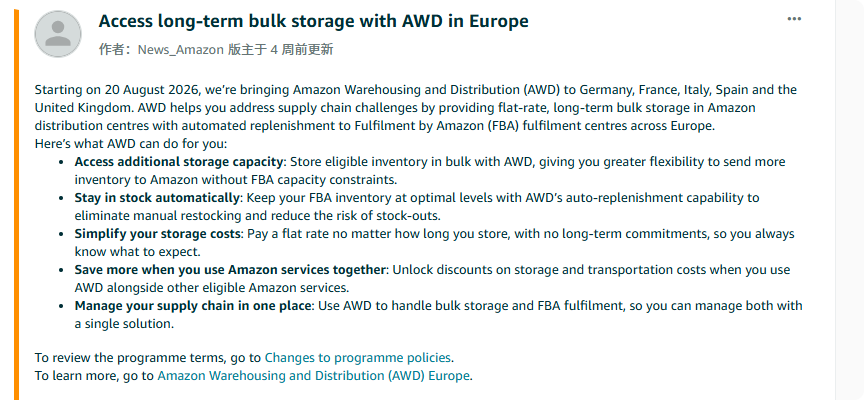
Image source: Amazon
What exactly is AWD?
In simple terms, AWD is a 'pre-positioned large warehouse' that Amazon has prepared for sellers. You can store large quantities of goods in Amazon's warehousing system in advance, and Amazon will automatically replenish them based on actual sales in FBA warehouses. You don't have to keep an eye on inventory and manually place replenishment orders; the system will handle it for you.
In terms of fees, AWD uses a fixed-rate model with no long-term commitment; the storage fee stays the same no matter how long you store items. Specifically, the basic storage fee for EU sites is €12.33 per cubic meter per month. If you ship through Amazon Global Logistics (AGL) and the automatic replenishment ratio reaches 70% or more, you can enjoy a discounted price of €11.09. For the UK site, the basic storage fee is £0.36 per cubic foot per month, with a discounted price of £0.32. In addition to storage fees, sellers also need to pay for inbound processing, outbound processing, and transportation to FBA centers.
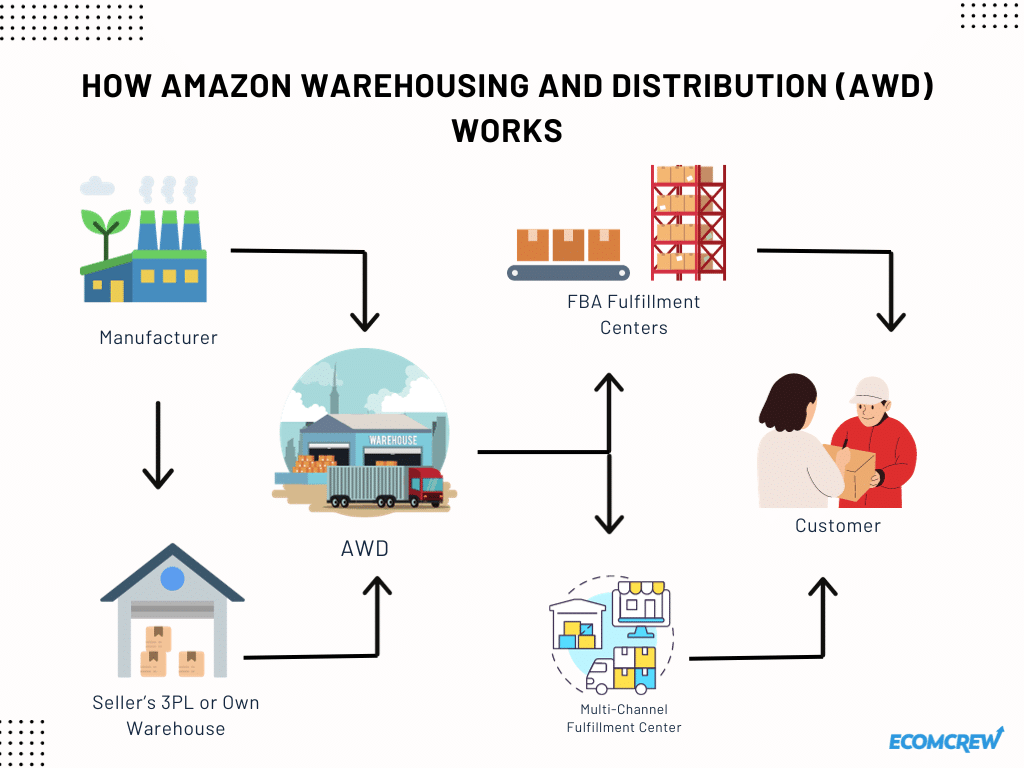
Image source: Google
What exactly is the difference between it and regular FBA?
The biggest difference lies in storage capacity limits. Sellers who have used FBA know that Amazon sets a storage capacity cap for each seller, making it difficult to stockpile more inventory. AWD can help you get around this limit—by placing goods in an AWD warehouse, it's like having an extra 'reservoir.' Even if the FBA warehouse has no space, your goods remain stored in AWD and the system can transfer them over at any time.
Especially during big promotions like Prime Day and Black Friday, sudden surges in order volume are common. In the past, what often happened was: before the promotion began, sellers desperately tried to stuff products into FBA, and if they couldn't, there was nothing to do but worry; once the promotion started, inventory was consumed faster than expected, restocking couldn't keep up, and they had to watch listings go out of stock. AWD's logic is to let you prepare inventory in advance, and the system automatically replenishes based on sales speed, reducing the risk of stockouts.
In addition, AWD's storage rates are fixed year-round and won't increase during peak seasons like FBA's do. For sellers who need to keep inventory for a long time, this makes cost expectations clearer.
Image source: Google
Overall
AWD's arrival in Europe gives sellers operating on European sites another option. Especially for sellers troubled by FBA storage capacity limits or those who frequently run out of stock during big promotions, this automatic replenishment mechanism can indeed solve some practical problems. Of course, it's not a panacea—the automatic replenishment threshold currently cannot be customized; you can only turn it on or off. The multi-channel supply function is also not yet available. But as a service that has just entered the European market, future optimization and expansion are still worth looking forward to.
For sellers on European sites, they can now go to the seller backend to learn about the specific usage conditions and fees. After all, being able to leave the troublesome task of inventory to automated system processing and worry less is a good thing.