 1170
1170
If you’ve ever thought about doing cross-border e-commerce, but after looking around you found yourself asking—what should I sell? 3C digital products are too competitive, clothing has a high return rate, and the logistics costs for large home goods are hard to calculate... This multiple-choice question is really not easy to answer.
But recently, there’s a brand that might give you some inspiration.
An outdoor storage box from Ningbo, China, sold7669 units in 28 days in the US region of Tuke, with sales exceeding $187,500. After 90 days on the shelf, total sales reached 16,500 units, with total GMV over $394,500, equivalent to about 2.7 million RMB. If you count from an earlier launch date, the same outdoor storage box under this brand has sold over 41,500 units in total in the US region of Tuke, with total GMV reaching $1,011,000, about 6.87 million RMB.
This brand is called BIFANUO.
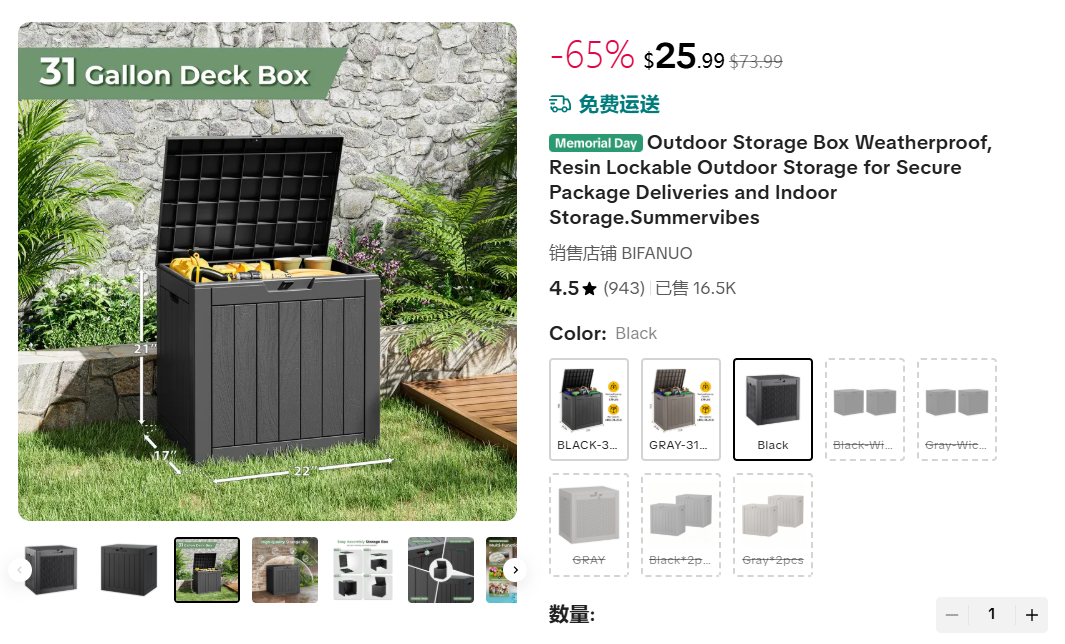
Image source:Tuke Shop
Standing at the wind outlet, you also need to learn to settle down
BIFANUO’s starting point is actually quite similar to the story of many cross-border entrepreneurs.
In 2019, co-founder Gram and two partners decided on their cross-border entrepreneurship plan at a dinner. None of the three had any experience in C-end cross-border e-commerce. Gram started from scratch, attending almost every available operations training course—paid and free alike.
They caught the 2019 Tuke boom and really benefited from it. Gram later admitted,“Back then, 80% of success was luck. Standing at the wind outlet, whether you understood or not, you could make money”.
But the story wasn’t so smooth. After the pandemic, demand dropped sharply, they overstocked early on, and inventory got stuck in their hands, almost losing everything they had earned. From 2020 to 2021, the team cleared inventory while stubbornly iterating products, slowly turning losses into profits.
Image source:Walmart
The turning point came in 2022, when BIFANUO officially joined Walmart Global E-commerce. In the second half of 2023, they began systematically operating Walmart store channels, while also focusing on Amazon, gradually shifting from“listing and selling products” to“branding and multi-platform matrix operations”.
Today, the brand has achieved results such as selling over a thousand storage boxes in a single Black Friday event on Walmart, and its double egg chair ranking TOP1 in the outdoor patio category. In just over two years, GMV has grown from hundreds of thousands of dollars to tens of millions of dollars.
This experience determined BIFANUO’s core capabilities: not relying on a single bestseller for life, but continuously running on supply chain control + multi-channel distribution + product iteration. This is very evident in their later Tuke strategy.
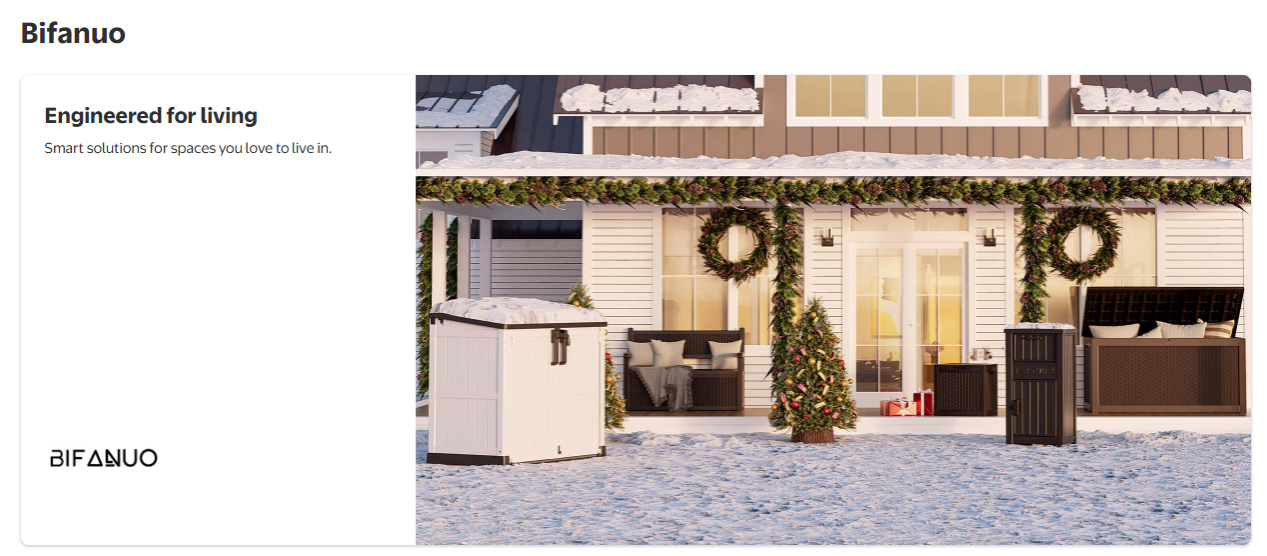
Image source:Walmart
Why “outdoor storage box”?
Many people’s first reaction is: it’s just a plastic box for miscellaneous items, what technical barriers could there be? Why did it explode in sales?
But if you’ve seen American family backyards, you won’t find it strange.
The proportion of detached houses in the US is extremely high, and yards/patios/decks are almost standard. Outdoor living culture is a real necessity—barbecues, camping, gardening, pool parties, kids’ outdoor toys, pets’ outdoor gear... The stuff just keeps piling up, and the storage problem has never been elegantly solved.

Image source:Google
In addition, the basic foundation of the North American outdoor leisure economy is also supporting the market. Public industry data shows that the US camping and outdoor leisure population is in the tens of millions (often cited estimates are over 40 million), and this group’s consumption chain ultimately falls on“gear → accessories → storage → yard maintenance”. Demand is not created, it is discovered.
Previously, outdoor storage boxes had stable sales on Amazon and other shelf e-commerce platforms, but essentially they are search-type products—users must first realize they need a box, then search and compare prices.
In this path, the category struggles to break out and reach those “people who haven’t decided to buy yet, but have been suffering from the pain point for a long time”.
Tuke changed this.
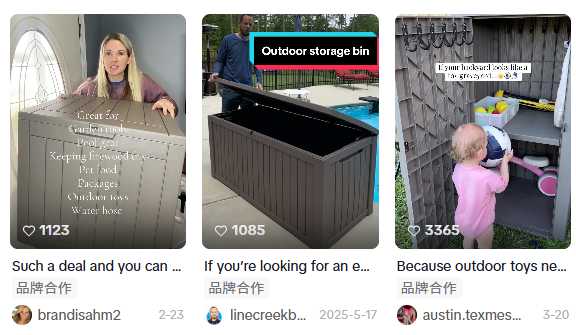
Image source:Tuke
How to sell a bestseller on Tuke?
Let’s look at the data first.
As shown in the figure below, BIFANUO’s transaction amount in the past thirty days was $911,700, with affiliate influencers accounting for 98.44% of the sales process.
In other words, BIFANUO’s current sales engine is completely driven by a massive number of influencers.
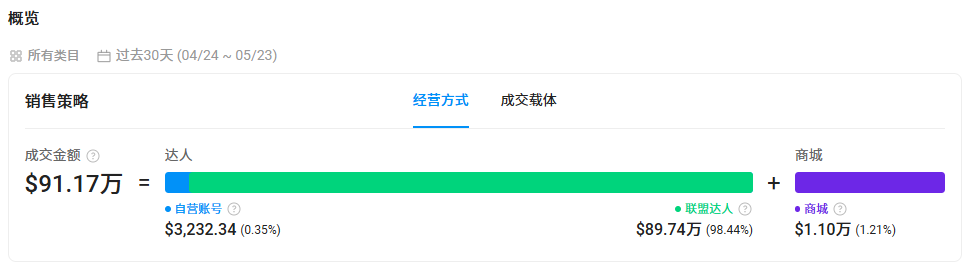
Image source:kalodata
Some might say: influencer marketing isn’t hard, just cast a wide net in the influencer square, send samples to a bunch of influencers, wait for them to post videos, and wait for orders to explode.
If you really do that, you’re making a big mistake. You need to understand one thing: The core of influencer connections is not “quantity,” but “precision.”
BIFANUO is very clear about influencer selection. They didn’t contact all influencers indiscriminately, but first did one thing: clarify who the user is?

Take the currently best-selling outdoor storage box as an example. The core buyers of this product are not trend-seeking young people, but American Moms who are tormented by backyard clutter.
These people are not looking for a decorative item to make their home look nice, they are looking for a solution that can “end backyard chaos, is affordable, and easy to install.”
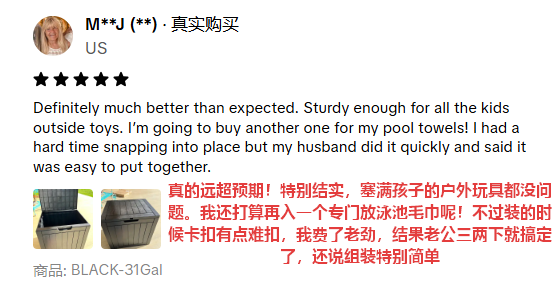
Image source:Tuke Shop
BIFANUO’s solution: around the content theme of “mom’s outdoor storage essentials,” they systematically connected with a large number of home and parenting Tuke influencers, and tied in with relevant trending topics such as #outdoorliving, #deckbox, #outdoorstorage, #momlifehacks, etc.
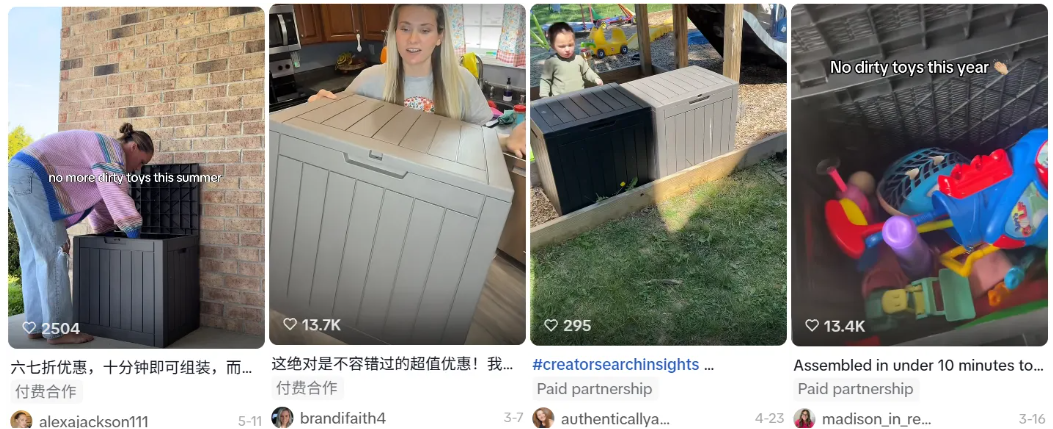
Image source:Tuke
Tuke influencer @maggieisamom is a great example.
In her May 2nd video, she first stuffed her kids’ toy cars, baseball bats, and various odds and ends into the box, only to find it wasn’t even full; then she washed it with a hose, opened it, and found it dry as new. One video clearly explained the two core selling points: “capacity” and “waterproof.”
Within less than a month of posting, the video has already received over 5.5 million views, and sales reached $82,300.
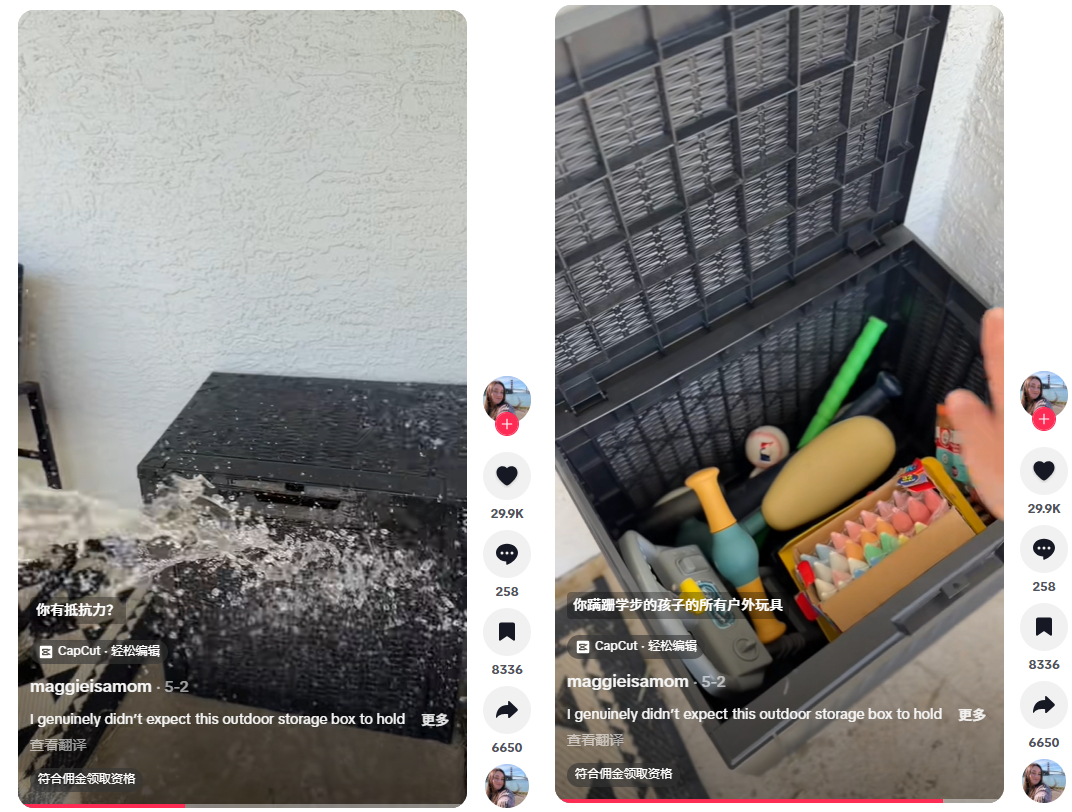
Image source:Tuke
Of course, BIFANUO hasn’t completely abandoned its own territory.
On their self-operated accounts, we can see a lot of AI-generated video content.
These contents are usually presented in the form of 3D animation or AI synthesis, focusing on quick product seeding and function demonstration. Although they lack the emotional resonance of real influencers, they win in low cost, fast updates, and wide coverage.
Since the rise of AI software, it has indeed brought great help to Tuke sellers. However, as homogenization intensifies, platform restrictions are also increasing. Everyone still needs to grasp the balance—absolute AI-ization is clearly not a long-term solution.
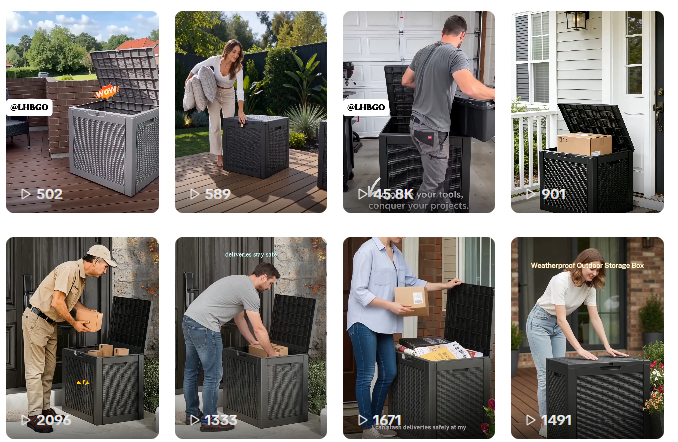
Image source:Tuke
Final Words
In the story above, BIFANUO is just a sample, a sample that happened to be noticed by more people.
What’s really worth the attention of domestic manufacturing companies and startups is not “whether storage boxes can be copied,” but the more fundamental rule behind it:
China’s supply chain depth advantage is real, but products alone are not enough. You have to find the demand scenario, then use the channels overseas consumers are immersed in daily to put your product into their life narrative, not just force it into their shopping cart.
In recent years, the phrase “brand Tuke” has been said too many times, so much so that it sometimes obscures a simple fact: the overseas market always has an appetite for things that are “useful, affordable, and solve real problems.”
A single box can travel from Ningbo to the backyard of Americans, relying on far more than just the box itself.